
Happy Accidents Meet Intentional Design in Jazz Cow
Without the luxury of a shaggy dog story

It’s 1961, some earnest advertising chaps stand on set, stroking chins, pondering brand strategy.
In runs a shaggy interloper, the director’s unruly Old English Sheepdog, running into the shot, and accidentally making ad history as the first Dulux dog. This fluffy creature’s accident brought the magic. It became a marketing hit that made the ad fellas feel pretty clever.
You see, film’s full of happy accidents, a sunbeam breaks through at the perfect moment, or a classic car parks in just the right spot.
But in animation? Nothing happens by accident. Every lamp post, costume, and prop is designed. Nothing’s free. I’m not complaining, it's part of the fun1. We may miss a free random dog, but, hey, we get to design everything. When it all clicks together, the story sings.
Right then, picture time! As I promised in my last post.
Our cartoon characters are the real stars. At some point, I’ll cover their evolution, the team behind them, and their influences. Today, we’re focusing on thinking, which creates the look. Hard to imagine anyone saying, “The characters, jokes, and story were fine, but that wonky tree in scene 2 stole the show.” Yet in animation, it matters. As I push this show forward, and others come on board, we need guardrails to keep the visual unity.
Humour me as I explain the logic, after all, I’m building in public.
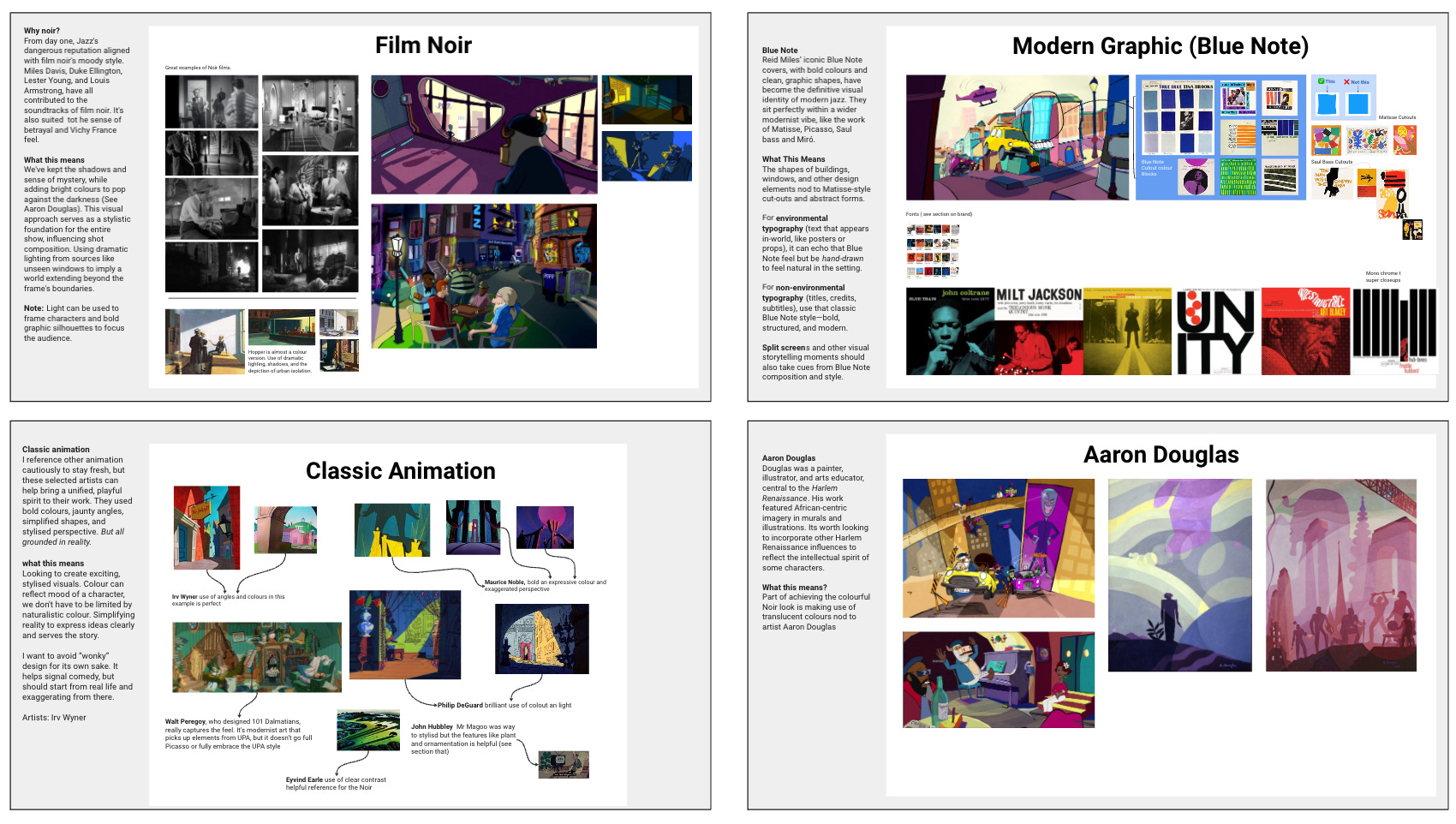
Shall we have a look, then?
At the heart of Jazz Cow is the conflict of two worlds, and their design reinforces the themes of the show.
The Bohemian Quarter is a chaotic human place of luddite misfits and creativity.
Popp World is an ordered place of convenience, safety, and uniformity.
The Look of These Two Worlds
Two places are both shaped by the beliefs of their residents over time. Each detail speaks of the people who call them home.
For now, we look at what drives the Bohemian Quarter’s folk. Freedom, self-expression, music, independence, art, poetry, chess, slow food, sunsets to jazz solos, resistance to tech and bookshops. This is Jazz Cow’s neighbourhood, human, chaotic, imperfect, a little broken, and alive.
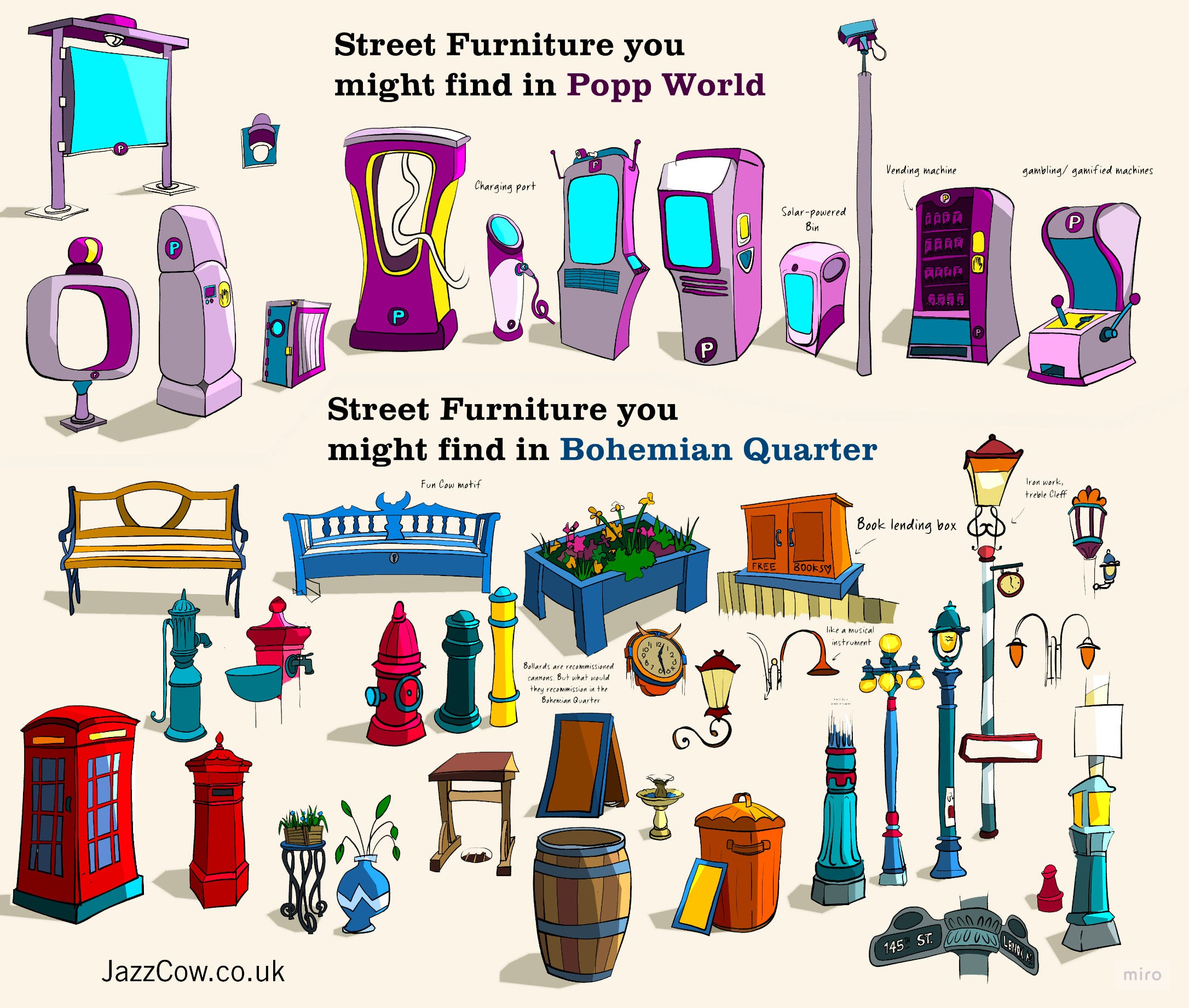
Nothing’s planned. No one agrees, not even on parade dates. Cars spill out everywhere. Street signs point the wrong way. And yet… somehow, it works. Sort of.
So what kind of world would these people make? Here, everything’s repaired, not replaced. Handmade beats factory-made, even if a bit wonky, and no plastic.
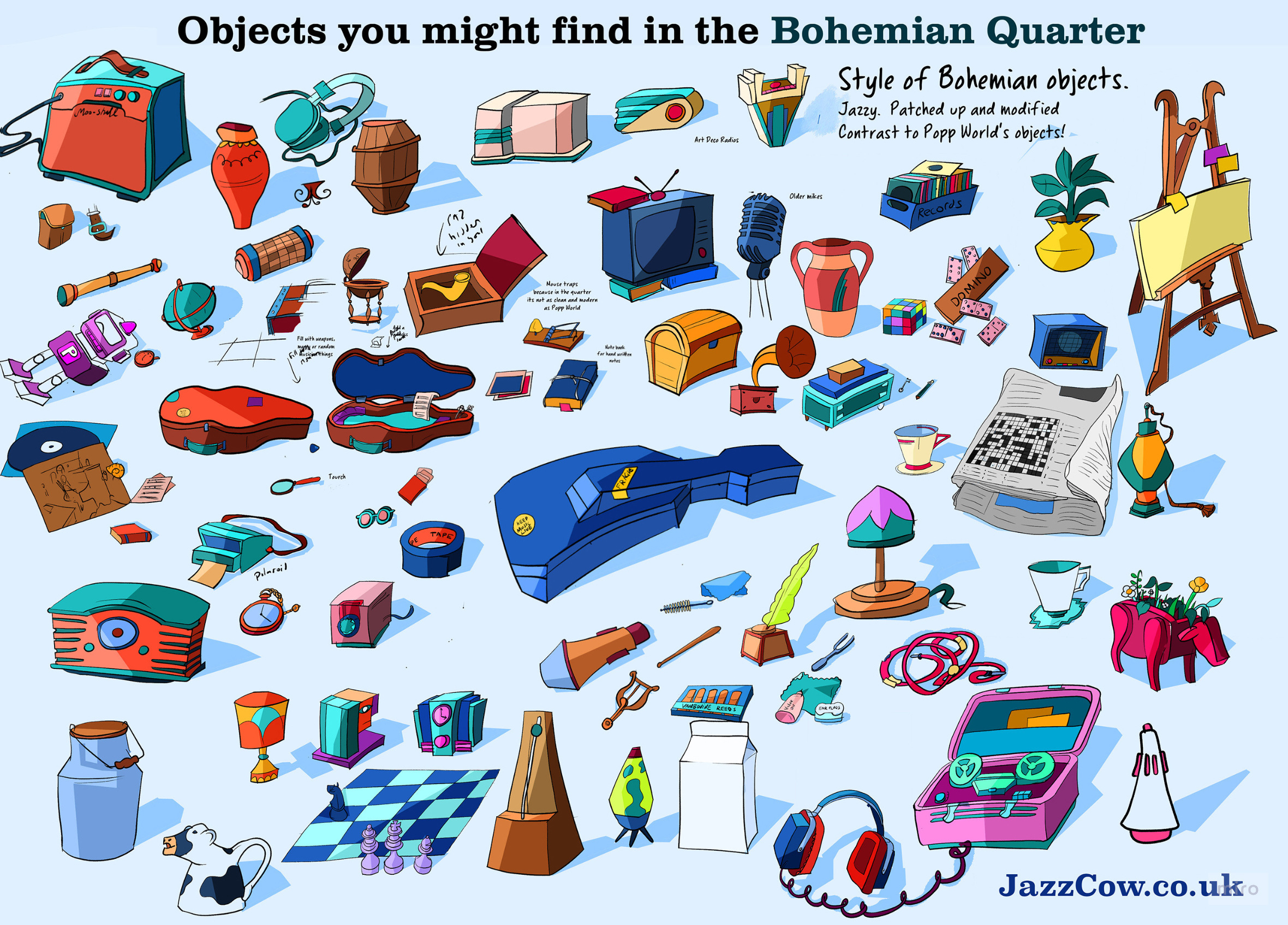
In the next part, I’ll go into the visual inspirations and the joyous art of cranking our observation of reality up to eleven. Because, in the end, isn’t that what the Bohemian Quarter is all about? Taking the world as it is and making it sing a little louder.
Just like that shaggy Old English Sheepdog who wandered into the Dulux shoot and accidentally made history, the Bohemian Quarter celebrates the unexpected, quirky details. Animation may be planned, but sometimes it’s the little imperfections that show we are human. Here’s to designing with intention… and embracing surprising, fluffy dog-like chaos.
I love how John Halls and Roger Manvell put it: “The cartoon set designer is more fortunate. He has more control over his medium.” — The Technique of Film Animation, 1971
Hi John, I remember the Dulux ad believe it or not and ads have dramatically changed as you've said, thought the premise has not to get more clients in the door! I work(ed) in marketing and advertising for years and find the work just never ends. Storytelling, building in public - just fancy terms we use to throw around now. When I look at apple I still think the pinnacle of great product is the product in and of itself that stands out. Anyway, loving the work you do here and finding it to be great fun, hope to see more along the way!